
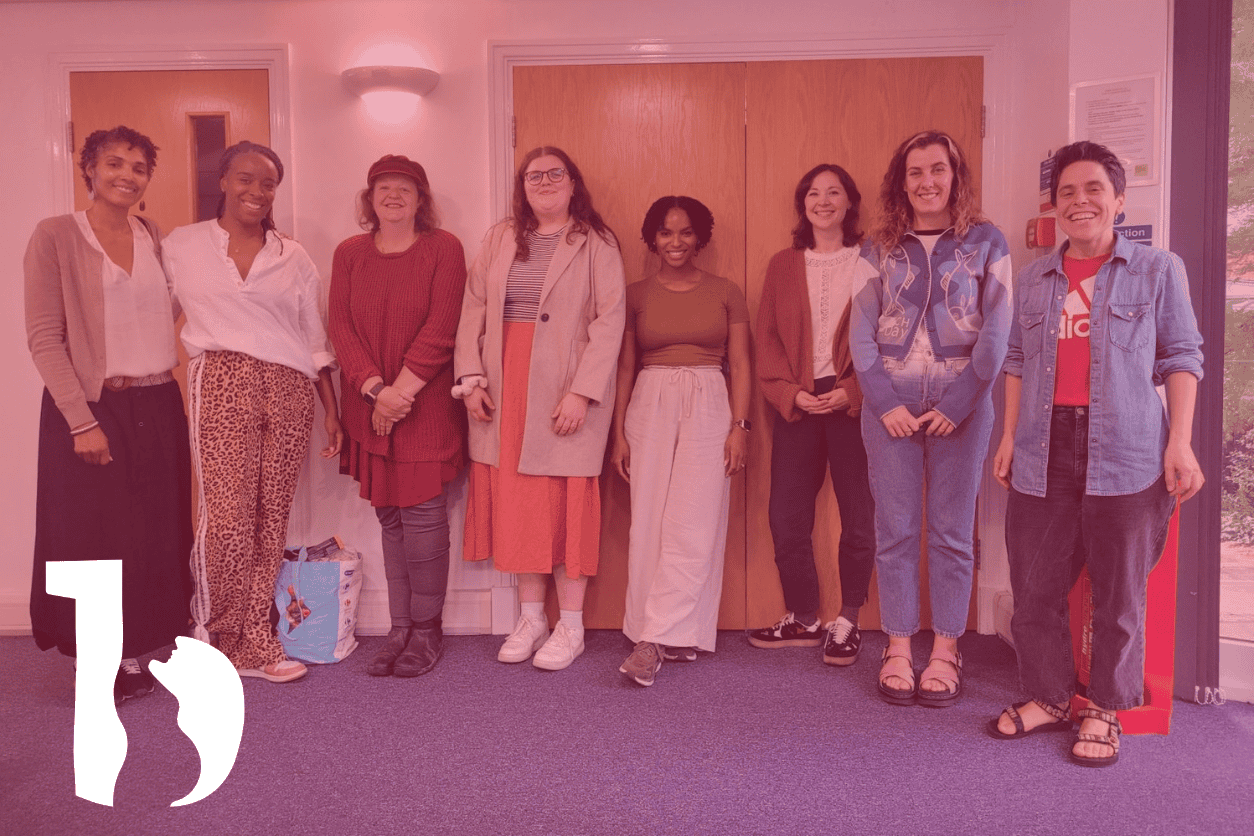
As she nears her first year in post, Birthrights’ CEO, Hazel Williams, reflects on our organisational values and how we are putting our commitment to anti-racism into practice.
What are Birthrights’ organisational values?
We are:
1. Human rights and justice–centred: The overarching value guiding all our work, is a commitment to justice and human rights-centred care.
2. Anti Racist: We recognise that systemic racism exists within the maternity system. We critically examine our own thinking and practice through reflection and learning. We will embed anti-racist approaches throughout our work and expose racism within the system we are part of.
3. Empathetic: We recognise that many women and birthing people have experienced harm, distress and trauma, and we show up with empathy and support to all who we work with.
4. Collaborative and in solidarity: We know that we are stronger together with others, so we work collaboratively and in solidarity with people who are working to achieve human rights-centred maternity care.
5. Bold: We are bold in our defence of human rights in maternity care and we will not shy away from holding institutions to account.

“As I approach my first-year anniversary at Birthrights, I am delighted that we are sharing our organisational values. These were developed collectively as a team and board. Our values sit at the core of all that we do, they are not a static list on paper but the heart and soul of Birthrights, our north star there to guide us, drive us, challenge us and hold us to account.”
“As a team we have decided to focus first on our anti-racist value – exploring how we do and do not live this, what it means to us and how we can ensure it’s the basis for our work.
I am acutely aware of how performative naming your value of anti-racism can be, look at us – we are anti-racist – we have it on our website – so it must be true! We recognise that we are not as anti-racist as we strive to be. We are absolutely committed to doing the work and rooting our work in anti-racist practice rather than just patting ourselves on the back.
Since joining Birthrights, I have had a few very welcome challenges about what we are doing on racial justice. It’s so interesting how uncomfortable these challenges immediately feel in my body, but I have to resist the white supremacy trait of defensiveness and listen (see Tema Okun: WHITE SUPREMACY CULTURE), be open and take these challenges as a gift to help us develop and change. There also feels like a balance between sharing what we have done with being performative and egotistical, a balance we are still working on.
At Birthrights we want to imagine the world as it should be and put our energies into that. Our 10-year strategy centres anti-oppressive practice across all our activities. We also understand that part of anti-racist work is getting your own house in order. As a white woman leading an organisation committed to being anti-racist, I am aware of my privilege and that I will always have much to learn. I am halfway through the year-long anti-racist leadership programme run by JMB and Social Justice Collective – which is personally challenging me to be more radical in my approach to leadership and what I am learning is shaping so much of what we are planning. Our Legal Lead has recently started a year-long course on unlearning white supremacy with New Ways, and in the new year as a team we will embark on a 6 month anti-racist and conflict training with JMB. I hear you – doing some training does not make you anti-racist. What it will give us, is the shared knowledge and tools, to collectively recognise when white supremacy traits show up in us and our work, and how to challenge this. It will help us practice how we hold discomfort and move through it with honesty, whilst creating an environment of collective care.
Our new operations team will be reviewing our HR policies and procedures to ensure anti-oppressive principles run through them all. The board will be working with external consultants to examine where power is held and how decisions are made.
We wrestled as a team with whether we have joy as a core value – I was very keen but there was a concern that women and birthing people contacting us with trauma and baby loss experiences, don’t particularly want to see joy blazoned across our website. We agreed to have it as an internal value. Coupled with joy is a belief in the value of creativity. As a team we have already been creating zines, drawing together and modelling plasticine – it helps that most of us have small children!
We continue the ongoing tasks to resist the white supremacy traits which show up so frequently both in us, our charity and the wider sector. The urgency culture is real – we recently got sucked into trying to rapidly read and respond to the National Maternity and Neonatal investigation and the Nottingham review reports – all 575 pages of them, then had to purposely stop ourselves, pause, reflect take time and respond meaningfully.
At Birthrights we hold vast amounts of knowledge which we see as communal. Over the next few years, we will be doing as much as we can to open source that knowledge in ways which are accessible including re-doing our website, developing easy reads, video explainers, translating our information and working in community to co-develop resources.
Part of this is our ambition to work in community with black and brown women and birthing people, to ensure they have the knowledge about their human rights which can be passed on, held in community and not easily dismantled. We also want the knowledge that they do have on what holistic maternity care can look like to contribute to policy and practice in transformative ways. We want these communities not just to access knowledge, but to contribute to its creation in meaningful ways.
Our policy, communications and campaign work will continue to centre black and brown women and birthing people. We will continue to call out racism and what needs to change – using the calls to action from the systemic racism: not broken bodies report as our guide. We have recently done this through our end coercive practices report, our calling out of the misogynoir we observed, through our attendance at APPGs and various national stakeholder meetings and in our role on the heath equity group, as part of the National Maternity and Neonatal Taskforce – where we continue to call out racism and the need for a human rights framework to be applied.
Over the next year we will be developing our community campaign and organising, starting to imagine together and progress our collective action for change. Exploring how we can work in community to build power and look at new ways of responding. Thinking about Bayo Akomolafe question: “What if the ways we respond to the crisis is part of the crisis?” And so beautifully put:
“There are things we must do, sayings we must say, thoughts we must think, that look nothing like the images of success that have so thoroughly possessed our visions of justice. May this new decade be remembered as the decade of the strange path, of the third way, of the broken binary, of the traversal disruption, the kairotic moment, the posthuman movement for emancipation, the gift of disorientation that opened up new places of power, and of slow limbs.”
This is just a flavour of what we have been doing and our plans. I can guarantee we will get things wrong. But one thing we do not want to be is victim to the white supremacy culture of fear – which can immobilise us in our quest to create the world we want to see – where human rights in maternity are respected for everyone.”
- ‘Divided: Racism, Medicine and Why We Need to Decolonise Healthcare’ by Annabel Sowemimo
- ‘Leading with Joy: Practices for Uncertain Times’ by Akaya Windwood and Rajasvini Bhansali
- ‘What White People Can Do Next: From Allyship to Coalition’ by Emma Dabiri – Re-read recently as so relevant with use of the term “ally” in the health sector.
- WHITE SUPREMACY CULTURE by Tema Okun
- ‘Race to the Bottom: Reclaiming Antiracism’ by Azfar Shafi and Ilyas Nagdee
- ‘A World Without Racism: Building Antiracist Futures’ edited by Virasami
- ‘What Would Emma Goldman Do?’ By Koshka Duff, Chris Rossdale and Matt Bonner